
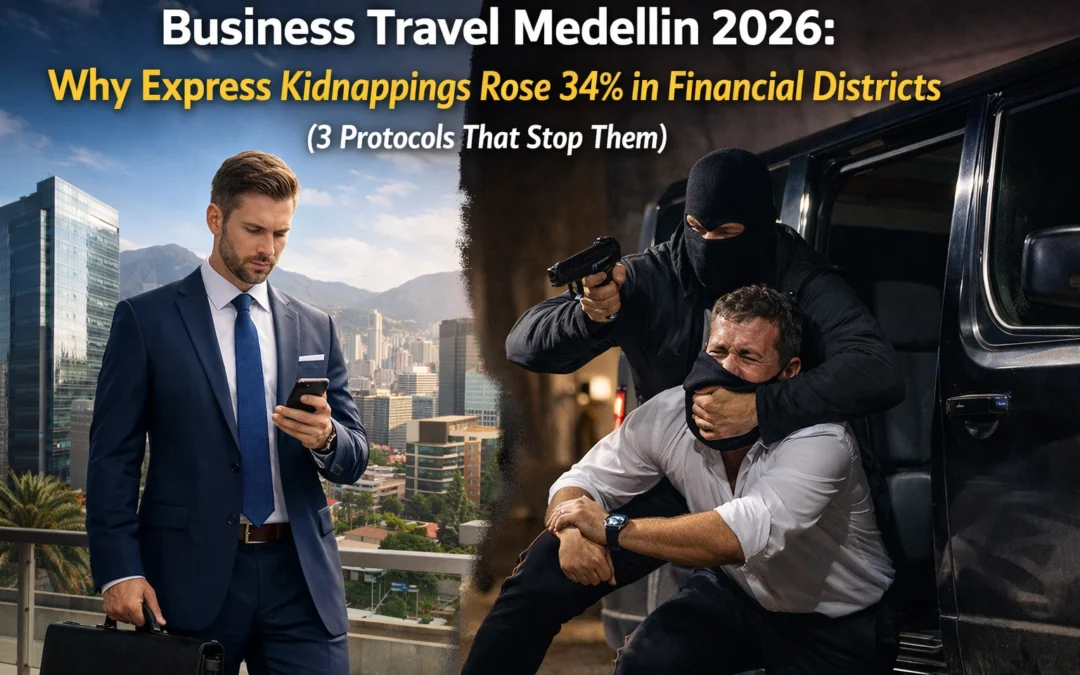
You've booked your flight to Medellín. Hotel confirmed. Meetings scheduled in Poblado's financial district. Then you start seeing headlines about express kidnappings targeting business travelers.
Here's what's actually happening: and more importantly, what you can do about it.
Why Business Travelers Became High-Value Targets
Express kidnappings aren't new to Latin America. But the profile of victims has shifted dramatically.

You're not dealing with random street crime anymore. Criminals have gotten strategic. They've figured out that business travelers carry premium credit cards, have access to company funds, and: here's the kicker: they're predictable.
Think about your last business trip. You probably:
- Took the same route from hotel to office
- Checked emails in the lobby every morning
- Used ride-sharing apps from the same locations
- Wore business attire that screamed "I'm here for work"
That predictability creates opportunity for organized criminals. They know where high-net-worth individuals congregate. Financial districts. Executive hotels. Business centers.
The targeting is deliberate. The window of vulnerability is narrow. And most business travelers don't even realize they're broadcasting their movements.
What Makes Financial Districts Different
El Poblado's banking corridor sees more foot traffic than Medellín's tourist zones. But it also sees more sophisticated surveillance.
Criminals stake out ATMs near corporate offices. They track who arrives in premium vehicles. They identify travelers who look disoriented or distracted by their phones while walking between appointments.
The average express kidnapping lasts 2-6 hours. Victims are forced to withdraw cash from multiple ATMs, transfer funds via banking apps, or hand over valuables. Then they're released in an unfamiliar neighborhood.
Sound terrifying? It should. But here's the truth: it's almost entirely preventable.
Protocol #1: Secured Ground Transportation (Zero Window Strategy)
Most express kidnappings happen during ground transport. The taxi you hailed outside your hotel. The rideshare that picked you up after dinner. The "helpful" driver who approached you at the airport.
Here's what stops it:
Pre-arranged secure transport only. No street hails. No last-minute rideshares. Ever. You need a driver who's been vetted, background-checked, and trained in defensive driving techniques.
Route variation. Professional drivers change routes daily. Same destination, different path. Criminals can't stake out what they can't predict.
Armored or inconspicuous vehicles. Depending on your risk profile, you're either traveling in armored protection or a completely unmarked vehicle that blends with local traffic. The goal: don't advertise that you're worth targeting.
Direct hotel-to-destination transfers. No stops. No detours. No "quick errands." The vehicle moves from Point A to Point B with zero exposure windows.
911 Medellin builds this protocol into every business travel package. You land, you're met airside, you move through secure corridors, and you're in a vetted vehicle before you hit public spaces. That's the zero window approach.
Protocol #2: Digital OPSEC (Stop Broadcasting Your Schedule)
You know what criminals love? Social media. LinkedIn check-ins. Instagram stories from hotel lobbies. Calendar invites with location details.
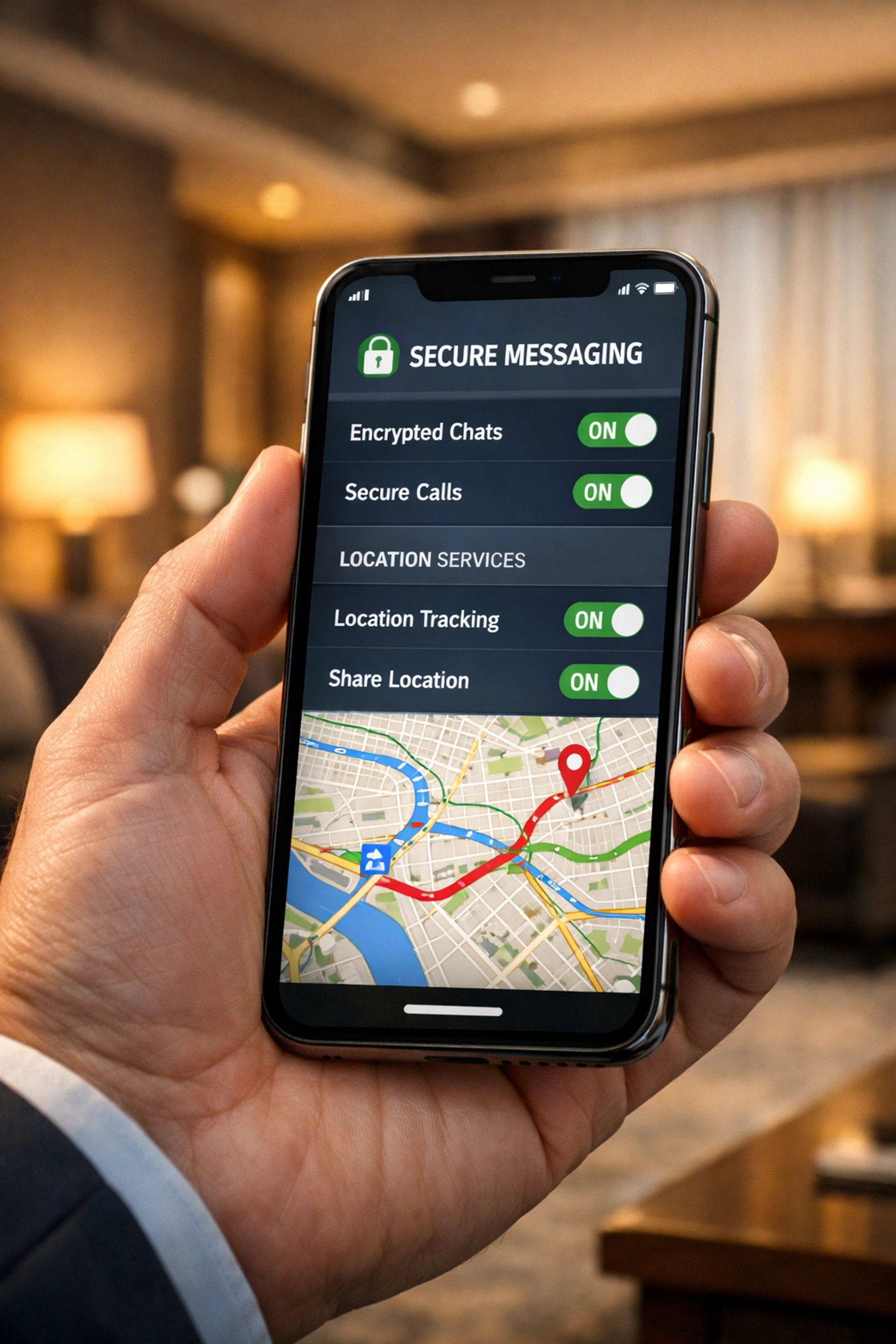
Your digital footprint creates a robbery blueprint. Here's how to shut it down:
Disable location services. Turn off geotagging on photos. Don't post in real-time. If you're sharing content from Medellín, do it after you've left the location: or better yet, after you've left the city.
Lock down your calendar. If your work calendar is accessible to people outside your organization, you've just published your entire itinerary. Make meeting details private. Remove location names from calendar titles.
Use encrypted communication. WhatsApp. Signal. Telegram. Assume standard SMS and email can be intercepted or socially engineered.
Brief your team. Make sure colleagues, assistants, and local contacts understand operational security. One well-meaning LinkedIn post: "Great meeting with [Your Name] in Medellín today!": can compromise your entire trip.
This isn't paranoia. It's basic operational security. The same protocols government contractors and executives use worldwide apply here.
Want to know how serious this is? Check out our post on why your social media posts are creating real-world risk.
Protocol #3: On-Ground Executive Protection (Human Intelligence Layer)
Technology helps. Secured transport helps. But nothing replaces trained human intelligence on the ground.
Shadow protection means you're accompanied by an armed, plainclothes professional who blends into the environment. They're not standing next to you in a black suit drawing attention. They're three steps behind, eyes on the perimeter, reading the room.
Here's what they're watching for:
- Surveillance indicators (people following, repeated vehicles, cameras pointed your direction)
- Choke points where you're vulnerable (narrow corridors, elevator banks, parking structures)
- Behavioral anomalies (someone too interested in your movements, coordinated groups, unusual loitering)
Active threat response. If something goes sideways, you need someone who can create distance, establish control, and get you to safety. That's not a driver. That's not hotel security. That's a trained close protection specialist.
Local network intelligence. Professional security teams in Medellín maintain relationships with local law enforcement, hotel security directors, and private intelligence networks. They know what's happening in real-time: not what made the news three days ago.
911 Medellin's executive protection specialists have military and law enforcement backgrounds. They've trained in high-threat environments. And they know Medellín's financial districts better than most locals.
If you want to understand the difference between shadow protection and traditional armed bodyguards, we've broken it down in detail here.
The Bottom Line: You Can't Secure What You Don't Plan For
Express kidnappings succeed because of improvisation. Victims didn't plan their security. They winged it. They figured they'd "be careful" and "stay aware."
That's not a security plan. That's hope.
Here's a security plan:
- Secured ground transport from arrival to departure
- Digital OPSEC protocols locked down before you land
- Executive protection scaled to your risk profile
Does every business traveler need armed shadow protection? No. Does every business traveler need secured transport and basic OPSEC? Absolutely.
The question isn't whether Medellín is safe for business travel. It is: if you approach it correctly. The question is whether you're willing to implement proven protocols or roll the dice.
Ready to Lock Down Your Next Business Trip?
We've secured hundreds of business travelers in Medellín's financial districts. From Fortune 500 executives to solo entrepreneurs managing high-value transactions.
Here's what we provide:
- 24/7 secured ground transportation with route variation
- Armed executive protection (shadow or visible presence based on your needs)
- Pre-trip threat assessment and OPSEC briefing
- Real-time intelligence monitoring throughout your stay
- Emergency response coordination with local law enforcement
Don't just take our word for it. Danny Tremblay, a business consultant who travels to Medellín quarterly, put it this way: "I used to stress about every meeting, every ride, every walk to dinner. 911 Medellin handles all of that. Now I focus on business, not looking over my shoulder. Worth every penny."
Get in touch:
📞 Phone: +57 324 618 5409
✉️ Email: info@911medellin.com
🌐 Website: https://911medellin.com
We'll brief you on current threat conditions, build a customized security plan, and make sure you land, conduct business, and leave without incident.
Because the best security story is the one where nothing happened.